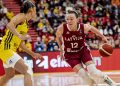
The brightest star of Latvia’s team of players born in 2010 and 2011, which won the country’s first European youth championship title, as well as of the entire FIBA U16 European Championship, was US-raised Bendžamins Jānis Beruē. The Latvian branch of his family has already produced high-level athletes.
His mother, Lāsma Jēkabsone, played 14 games for the Latvian women’s national team and represented Latvia at five European youth championships, including as part of the team that won Latvia’s first bronze medals at the 2005 U20 European Championship. His grandfather, Ainārs Jēkabsons, became a Soviet Union volleyball champion with Riga’s Radiotehniķis in 1984 and won the 1983 Spartakiad of the Peoples of the USSR with the Latvian team.
Beruē’s contribution to the team was reflected in his tournament averages: 33 minutes per game, the most in the championship; 23.6 points, the highest scoring average in the tournament; 15 rebounds, also the best result; 4.1 assists; and a tournament-leading 3.6 blocked shots. His efficiency rating of 36.3 was the best ever recorded at a European U16 Championship.
Of the other 11 players, five had spent one or two seasons developing in basketball systems abroad in Italy, Spain and Dubai. Nevertheless, all of them took their first steps in basketball in Latvia, representing different regions and sports schools.
No. 1 Rolands Teikmanis: 7 games, 21 minutes, 6.7 points and 4 assists per game
A product of RBS Jugla and coach Ziedonis Jansons, Teikmanis began training at a very young age. He also spent a short period at Basketbola klase under Kristaps Kozlovskis.
Coming from an athletic family, Teikmanis uses his natural physical strength and power on the court to compensate for his lack of height. He did not look out of place even among teammates and opponents one year older than him.
He had operated as a “scoring machine” for his sports school team, but at the European Championship he also demonstrated impressive point guard skills. Those abilities should prove useful at next year’s U16 European Championship as well.
No. 3 Ralfs Barlots: 3 games, 9 minutes, 1.3 points and 4 rebounds per game
Barlots began playing basketball at Riga Secondary School No. 64 under coach Aleksandrs Feldmanis, who recommended the promising youngster to RBS Centrs coach Krišs Matisons.
He has excellent size for basketball and a calm, peaceful character. A positive and intelligent young man, he performs well academically and adapted quickly to his new environment in Italy.
Time will tell whether moving to Italy at the age of 14 was the right decision from the perspective of his sporting development. He was added to the U16 national team at the last moment and still has considerable untapped potential.
No. 6 Kristians Martinsons: 6 games, 17 minutes and 5.3 points per game
Martinsons learned the fundamentals of basketball at Bertāni Valmiera Basketball School under Roberts Zeile. He began training in the first grade and immediately stood out as the best player in his group: taller, stronger and already equipped with some basketball experience gained from playing with his father.
His family’s support has been, and continues to be, extremely important in helping him pursue his sporting goals. His performances at international tournaments caught the attention of FC Barcelona scouts, and at the age of 13 he joined the Spanish superclub’s youth system.
Martinsons will also be eligible to play at the U16 European Championship next year.
No. 9 Markuss Jahovičs: 7 games, 29 minutes, 18.1 points and 4 rebounds per game; tournament All-Star
Jahovičs took his first steps in organised basketball at Basketbola klase under coach Maija Čunda. Ilgonis Pīlāgs later took over his development and guided the team of players born in 2010 to Swedbank Latvian Youth Basketball League championship titles in five age groups.
According to his coach, Jahovičs displayed determination, natural leadership and composure from an early age, which led to him being named team captain. His height and physical strength allowed him to compete successfully with players one year older.
He also possesses a natural shooting touch that required only a minor adjustment to his hand movement. He does not become stressed on the court, something that was clearly visible and appreciated at the European Championship.
No. 11 Gustavs Vilcāns: 7 games, 24 minutes, 8.4 points and 3.3 rebounds per game
Vilcāns is a product of Ogre Basketball School and coach Artūrs Bērziņš. His fighting spirit and winning mentality have been evident since his first training sessions.
At first, setbacks occasionally brought him to tears, but over time he learned to control his emotions. His coaches have never needed to check whether he has completed an assigned task during training.
He played well at the European Championship but is certainly capable of even more. As he matures physically, he will be able to make full use of his broad range of skills.
No. 13 Gustavs Ķirsons: 3 games, just under 8 minutes per game
Ķirsons began playing basketball in Rēzekne under coach Aleksejs Grehovs, whose team model assigned him the role of a sharpshooter. In the U13 age group, the team was coached by Igors Golovka, who recognised Ķirsons’ potential as a versatile player.
He is a good shooter, communicates well with his teammates and can play both facing and with his back to the basket. During that season, he played successfully in the first, second and third positions.
He later found his way to Bertāni Valmiera Basketball School. Ķirsons struggled to settle into the game at the beginning of the European Championship and consequently received limited playing time. His natural ability has not disappeared, however, and continued hard work should provide him with strong opportunities for further development.
No. 15 Emīls Hauka: 6 games, 9 minutes, 2.7 points and 1.5 rebounds per game
Hauka began playing basketball in Jēkabpils under coach Aigars Vanags. He attended training diligently and regularly recorded double-doubles in National League games, although his two-metre height initially attracted more attention from the regional team’s coaches than his level of skill.
He did not make the U15 national team last year, but a season at Ogre Basketball School and experience in both the LJBL Super League and the Regional Basketball League helped him take a major step forward.
Hauka is an excellent example of how hard work and a positive attitude can help a player progress to the Latvian national team and even become a European champion.
No. 16 Juris Sičkars: 6 games, 14 minutes, 4.7 points and 2.8 rebounds per game
A native of Jūrmala, Sičkars has trained under Mārtiņš Liepa and Gundars Siliņš since childhood, keeping pace with players one year older than him.
He inherited his basketball genes from his father and was immediately noticeable on the court. For a long time, he was the tallest player on Jūrmala’s teams, but during training and games he also developed perimeter skills that now make him a particularly difficult opponent to defend.
Sičkars spent the beginning of the season recovering from an injury and missed the first round of the LJBL championship. He later regained his rhythm and confidence, delivering excellent performances at the Swedbank LJBL U15 and U16 final tournaments. His teams finished first and third respectively, while Sičkars earned MVP and All-Star honours.
An excellent student and determined competitor with a good sense of humour and a tendency to be at the centre of attention, he will also be eligible to play at the U16 European Championship next season.
No. 25 Mārtiņš Rasnačs: 7 games, 12 minutes and 2.4 points per game
Tukums Basketball School coach Sandis Poga, who also served as one of Edijs Šlesers’ assistants at the championship, stresses that Rasnačs’ medal represents the culmination of the long and patient work invested in developing the Tukums regional basketball system in recent years.
Rasnačs’ talent is characterised by explosive speed and accuracy from mid-range and long distance, although he did not have the opportunity to demonstrate these qualities fully during the championship.
He has developed alongside a team that, two years ago, won the first LJBL bronze medal in the history of Tukums. Rasnačs has played for Latvia’s U14 and U15 national teams, taken part in individual development camps and gained experience in the Ramirent National Basketball League.
As he matures physically, his confidence should also increase, giving him strong prospects for further development.
No. 26 Matīss Preimanis: 6 games, 17 minutes, 8.2 points and 3 rebounds per game
Preimanis grew up in Limbaži and first attended basketball training led by Kristaps Zaļupe together with his friends. He soon attracted attention because of both his physical development and understanding of the game.
He inherited his athletic qualities from his father, a versatile sportsman. Limbaži cannot assemble complete groups for every age category each year, so younger players frequently have to compete against boys one year older. Although this is challenging, it also promotes development.
An invitation to join the regional team provided a major boost to Preimanis’ development. It helped him believe in himself and gave coaches an opportunity to assess his abilities.
Last season, he continued his development with Sigulda Sports School, with which the most talented Limbaži players had previously competed in international tournaments. Preimanis’ fighting spirit was particularly evident at both ends of the court during the decisive moments of the European Championship.
No. 94 Markuss Aleksandrovs: 7 games, 26 minutes, 11.3 points, 4 rebounds and 3.4 assists per game
Aleksandrovs was introduced to basketball in Rugāji and developed at Gulbene Regional Sports School. His first coach was Sandis Dzērve, while in the LJBL he also played alongside older boys under Oskars Vīksna.
He inherited his height from his father, complementing it with natural fighting qualities. Aleksandrovs captained the Gulbene team for several years before spending the past two seasons training and playing in Italy, where a recommendation from Luca Banchi helped him secure an opportunity.
A selfless player willing to perform basketball’s “dirty work”, Aleksandrovs distinguished himself at the European Championship both through his rebounding and scoring. He finished as Latvia’s third-highest scorer.
Guntis Keisels, basket.lv